Author: Ee Chia

  • The First Annual Assessment Visit

    The Board of Trustee (Trustees) conducted our first annual assessment visit to Iskul Sama diLaut Omadal from 14 to 30 September. Hui Ling and I flew to Semporna to meet Adzmin and Shafiyyah at our own expenses. This 17-day trip provided us better understanding of Iskul’s classes, students, Mastal Arikiks (little teachers in Bajau) and the headmistress. As insightful as the trip may be, however, it was not without challenges.

    The first challenge was the security risk. Two days before our depature, news reported kidnapping of a fisherman off Semporna water. Our dive operator friends advised us against staying on the Omadal island. Interestingly, local islanders feel otherwise. Semporna town residents find it dangerous to travel to non-touristy islands i.e. Omadal but the islanders disagreed. Honestly, we were worried for many days, before and during the visit, especially on our trip to and fro Omadal. For security reasons, when in Omadal, we reported our presence to the General Operation Force’s (Pasukan Gerakan Am, PGA) base. We randomised our visits to the island and stayed a total of 10 nights. PGA advised us against roaming around when darkness sinks in. Overall, throughout the visit, we didn’t wander too far off the kampung areas. We find the island pleasant to visit especially to interact with Bajau Laut children as they gather in the evening to play. However, this security risk made it infeasible for outsiders like us to work in Omadal.

    Throughout our stay, we conducted (i) seven Focus Group Discussions of threes with most of our students, (ii)13 individual interviews with our students, little teachers and headmistress,(iii) two impromptu tests for both our students and little teachers and (iv) observations as ways to collect data to understand Iskul better. Hui Ling and myself also taught a few classes which helped us to understand why our little teachers splitted the students into smaller group for better management. It was a joy to see our students eagerness in learning and wanting more classes. They were proud of their new Iskul’s t-shirt and wore it for all classes. They also displayed a persistent spirit in completing all test questions despite not knowing the answer.

    Unfortunately, our in-class observation showed that our Mastal Arikiks are weak in teaching. Students were taught to memorise without understanding what they were learning. The class typically began with the little teachers writing on the board and students copied what was written. After about 45mins, the little teachers read out the words, but  always explaining what it means. Futhermore, their teaching methods and class control lack creativity and fun elements.

    The difference between the students’ eagerness in learning and the Mastal Arikiks’ lack of enthusiasm and teaching skills is apparent. Our little teachers had no teaching plans and repeated words taught previously. We were disappointed at this discovery. However, we understand that our Mastal Arikik are still young and they don’t have the capacity to teach like teachers. Their teaching methods possibly reflects how they learn in school (which indicates a greater problem in our national education system)! Hence, we invited a friend, Cikgu Wai Yan to guide our MA on how to prepare lessons before class.

    Nonetheless, a few students can read/write/recognise A-Z, 1-50, certain words, while the rest are still learning. Together with the Mastal Arikiks and headmistress, we reshuffled the classes according to the students’ level. As our fund was running low and to reevaluate our young teachers’ teaching motivation we resolved to remove their RM50 monthly allowance for the next six months from October 2016 to March 2017. As a result, two Mastal Arikiks who recently joined us quitted. They even discouraged other children from teaching in Iskul without allowance. Thankfully, our three founding Mastal Arikik decided to continue teaching despite no allowance.

    Another shocking discovery is our Mastal Arikiks’ poor school results. Their grade for Bahasa Malaysia and Mathematic are below 40 marks (fail). This shattered our initial assumption that our little teachers pass all their subjects in school.

    Hence, we refocus the project into two fold. Firstly, to provide basic literacy to the stateless Bajau Laut children. Secondly, to build capacity of rural students in Malaysia. We want to build young leaders within these two communities.

    Therefore the next one year, our focus will be:

    • To build the capacity of our young teachers so they can teach
    • To fundraise to build a structure for Iskul so that the children have a proper place to learn
    • To elevate the self-esteem of out students – to empower them to become assistant MA to teach their friends, and hopefully they can become MA later.
    • To hire a field coordinator to support the Mastal Arikik, students and headmistress as well as to become communicator between them and the Trustee and more


    The assessment trip was intense, we had so many ideas but we can’t implement them without being there. The funding coupled with the security issue made it hard for us to work in Omadal. Nonetheless, we are resolved to continue to support Iskul and to build leaders among the stateless and local communities in Semporna!
  • The Bajau Laut Community in Semporna at a Glance

    The Bajau Laut Community in Semporna at a Glance

    I first met Ginara in July 2013 when I was in Mabul Island in Sabah. She has one of the most captivating smiles I’ve seen. She was about 8-year-old. She came to us in her little sampan (boat), begging for food, money and clothes. Later I discovered that she’s a Bajau Laut girl. She and her family live in the boathouse about 5km from the guesthouse that I was staying.

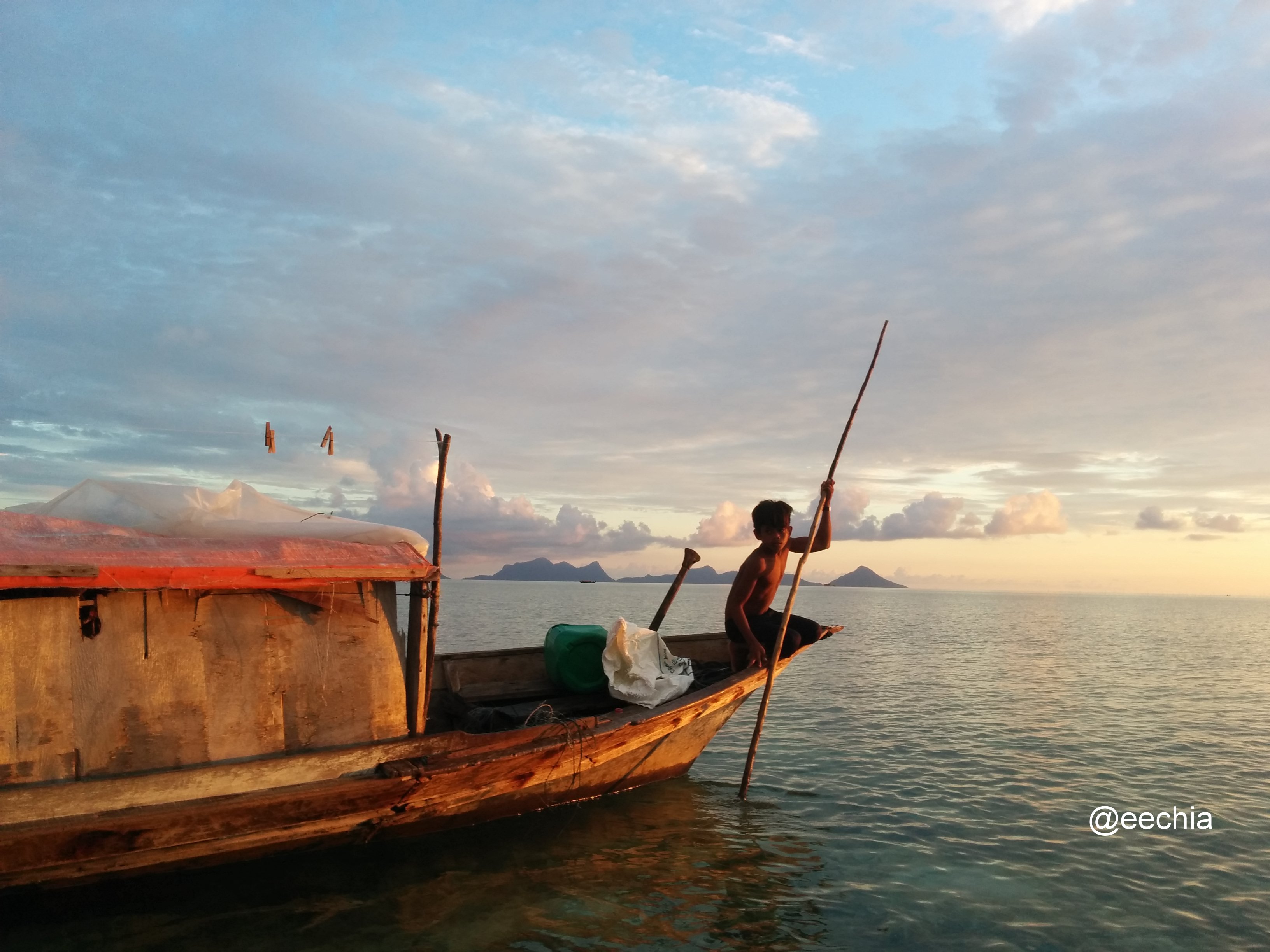
    When I saw how Ginara, her parents and three siblings crammed into that small boathouse (lepa-lepa), I was intrigued. I decided to research more on the Bajau Laut people. I discovered that they are one of the last surviving sea nomads in the world. In Malaysia, they are stateless or undocumented and live on subsistence fishing.

    They are famously known as sea gypsies or sea nomads. They live in small family boats or lepa-lepa in the sea and rely on marine resources for living¹.

    In recent years, others have moved into stilted wooden houses on the sea. They still use the lepa-lepa as their primary transport. Both the lepa-lepa and house have no electricity and fresh water. They sell their catch to the local community, seafood restaurants, tourists and fish operators.

    They are also one of the small-scale suppliers of the luxurious Live Reef Fish Trade (LRFT) in Southeast Asia². They are poor and are often socially marginalised by the general public “for their nomadic seafaring way of life”³. They are called derogatory terms like pala’au or luwa’an, “meaning, literally, ‘that which is spat or vomited out’”⁴. Their average monthly fishing income is only enough to survive, insufficient for anything beyond necessities⁵.

    The area where they are living is where I was in Sabah. It is part of an area known as The Coral Triangle.

    The Coral Triangle has more marine species than anywhere else on the planet. It is known as the Amazon of the Sea. It also covers the water of five other countries. These countries are Indonesia, the Philippines, Papua New Guinea, Timor-Leste, and the Solomon Islands. The Coral Triangle is the global centre for marine biodiversity.

    Why are the sea-nomads in Sabah?

    Their history is complex and multifaceted.

    Some of the Bajau Laut sea nomad communities have inhabited the islands of Semporna before the formation of Malaysia.

    Others arrived after 1963. Some are the descendants of evacuees who fled the Sulu armed conflict. They escaped political instability in Southern Mindanao, the Philippines in the 1970s.

    These individuals sought refuge in Sabah. Back then the evacuees included other groups of people like the Suluk and Bajau.

    Malaysia was caught in a refugee crisis. As a result, the country received humanitarian support and financial aid. The support came from the United Nation High Commissioner for Refugees (UNHCR), the International Red Cross, and Saudi Arabia. The renowned diving island Pulau Mabul formerly known as the UN Island was used to settle the refugees.

    Now, despite the presence of resort and dive operators and tourists, Pulau Mabul is still inhabited by the refugees. They are a mix of Suluk, Bajau, and Bajau Laut. Many of them are undocumented. Hence they can neither be enrolled in school nor work legally in Semporna.

    Some of them have the IMM13 document issued by the Immigration. They can study in SK Pulau Mabul and work. But, many do not have such opportunities.

    Historically, the Bajau Laut community is part of the wider Sama-Bajau-speaking people living in Borneo, Sulu Archipelago and Eastern Indonesia. In Sabah, the latter consists of land-based and shore-based peoples⁶. The land-based people are commonly known as Bajau Darat can be found on the West Coast.

    On the East Coast, there are two different communities of shore-based people. One is the nomadic/semi-nomadic Bajau Laut, which is Ginara’s community. The other is the settled/mainland Bajau (Bajau). They are possibly also known as the Samals (Samales Laut), originated from Sulu⁷.

    Even though both groups speak a similar language, they are different culturally. The Bajau/Samals are Muslim while the Bajau Laut are pagan, and often assume a more inferior status. Scholars suspect that both descended from the same sea-roving ancestor, but the Samals would reject such hypothesis⁸. The Bajau identifies themselves according to their island of origin, e.g. Bajau Ubian, Bajau Simunul.

    Currently, there are two different groups of Bajau Laut in Semporna who describe themselves as Sama diLaut or a’a dilaut.

    One group has Malaysian citizenship while the other does not. The first group managed to register as citizens in 1963 during the formation of Malaysia and have are sedentarized. They mostly live in Kampung Bangau-Bangau, the first Bajau Laut settlement since the sixties.

    The second group are stateless who are still nomadic and semi-nomadic. Some of them have inhabited in the islands in Semporna before 1963 like Ginara’s grandparents.

    Others came after 1963, even during the Mindanao’s crises. Some of them live in marine parks. Others reside on islands surrounding TSMP, like Pulau Omadal and Pulau Mabul. Some live along the coast of Semporna town.

    Some people still live in their lepa-lepa, leading a nomadic lifestyle. They move around between these three places. Others have built their stilt houses, like Ginara’s parents.

    After my first meeting with Ginara in 2013 in Pulau Mabul, she has followed her parents to Pulau Omadal. She now attends Iskul Sama diLaut Omadal together with her other stateless friends.


    1. Sopher 1965; Sather 1997; Ali 2010
    2. Clifton & Majors 2012, 718; Teh el al. 2011, 457
    3. Saat 2001; Torres 2005, cited in Tel el al. 2011, 457; Clifton and Majors 2012, 717
    4. Kiefer, 1972a: 22; Sather, 1984: 12-13, 1993a: 30 cited in Sather 1997, 6
    5. Teh el al. 2011, 456; Clifton and Majors 2012, 717
    6. Sather 1997, Rahim, Osman and Dambul 2012
    7. Rahim, Osman and Dambul 2012, 29; Sopher 1965, 122
    8. Rahim, Osman and Dambul 2012, 29; Sopher 1965, 122

  • The Beginning of Iskul

    Semporna has many beautiful islands, endowed with turquoise water and pristine sand – look almost like heaven on earth. Yet if you walk around Semporna downtown, you will see many children running around barefooted, begging for money and food.

    A serene view of the coastline in Semporna, showcasing traditional boats and lush greenery against a backdrop of turquoise waters and a clear blue sky.

    Occasionally, you find a woman walking with them. These children mostly have hair with golden streaks. This results from the sea-water bleaching since young. They are the children of the subsistence Bajau Laut fishermen. Most of them have no national identity even though they are born here.

    In the 1970s, many parents fled the armed conflict and political instability in Southern Mindanao, the Philippines. They sought refuge in Sabah.

    The Bajau Laut are also known as subsistence fishermen and sea nomads. Some of them still live in their traditional wooden boat known as lepa-lepa. Others have moved into wooden stilted houses. Both the lepa-lepa and house have no electricity and fresh water.

    The Bajau Laut children are trapped in the inter-generational cycle of poverty. Having no Malaysian citizenship, the children are incapable of attending school (or even work).

    When they are not fishing with their parents, they are left roaming in the town, begging for food and money. In recent time, many of them have started the habit of glue-sniffing. It was said that children sniffed glue to escape the feeling of hunger.

    You asked the children what they feel when they sniff glue. They would tell you tales of an out-of-body experience. They feel a happiness that casts all their worries and humiliation away. They became addicts. These were my observations during my thesis fieldwork on the Bajau Laut community in Semporna.

    When I was in the Omadal island for my fieldwork, I was taken aback. I saw similar patterns with the Bajau Laut children there. They sniff glue. They hardly speak Malay. They were not capable of attending school.

    Once, I get to speak to the children through a little girl of Bajau Laut and Bajau parentage, Sakinas (Kinas). She became my translator as she can speak both Malay and Bajau. Through her, I asked the Bajau Laut children (mostly  her cousins and playmates) if they want to go to school. Many of them shook their head because they think they are not smart enough for school.

    Many feel shy and inferior to be in school as they have never been to one. I then asked if they would give it a try if Kinas teaches them instead of a schoolteacher. Their eyes brighten up and nodded their heads. I asked the 11-year-old Kinas if she’s willing to teach her friends on weekends and receives a small allowance. She nodded.

    The first meeting after the trial class.

    I quickly ran back to discuss with my host, Kak Roziah. She agreed to the idea. She introduced two more people: her 11-year-old son, Fazlan, and a 14-year-old teenager, Khairul, who can also be teachers.

    We promptly had a meeting. The three young teachers, Kinas, Khairul and Fazlan, agreed to a trial class (you can view the video here).

    During the trial class, they decided that they needed one more teacher to help, so they included a 14-year-old Syakila. That night, after the trial class, we had a meeting – the four young teachers, Kak Roziah and myself. The young teachers were all so excited and energised after their first teaching experience.

    I asked how did they feel, they replied “Best!” and indicated that they want to continue teaching. We discussed about the setup. The school name is Iskul Sama DiLaut Omadal (Iskul).

    We talked about its vision and the allowances. The allowances are not confirmed as they depend on donations. We also discussed the teaching plan, classes, and other details. Everyone spoke their minds and we recorded our decisions in the meeting minutes. They agreed to teach their Bajau Laut friends basic literacy, arithmetic and arts.

    The next day, I travelled to Semporna town with Khairul and Kak Roziah. We went there to get the necessary stationery. I also posted a plea for donation on my Facebook for Iskul! So, we finally started our first class 1 of August 2015!

    The formation of the Iskul would not be possible without the support of many friends. They donated in cash and in-kind to sustain its operation for one year.

    We created a Board of Trustees (Trustees) because Iskul was (and still is) not registered. The Board was formed to keep tabs on donation and expenses. It also supports and oversees the operation. The Trustees was formed in August 2015 when Adzmin and Hui Ling joined us.

    We meet bi-monthly to discuss Iskul progress. We disburse monthly allowance to the young teachers. They are also known as Mastal Arikik. This means Little Teacher in the Bajau language.

    The last one year has been a learning experience for the Board of Trustees. Personally, I observed the pivotal role of local knowledge. Local community participation also plays an essential role in the sustainability of the project. It is the ownership of the local community that spurs the project further.

    The Bajau Laut children also taught me an important lesson. According respect and dignity to the recipients of aid unlock the potential they have. I have not seen any group of children who are so eager to learn as these stateless children of Omadal. I’m ever grateful for this experience.

    To find out about the highlights of our first year, read Year 1 – The Experiment