Tag: Student Development

  • COVID-19 Food Aid

    During the COVID-19 outbreak, Iskul ran a two-fold food aid programme for B40 residents in Omadal. Below is a brief overview of the beneficiaries of our food aid programme.

    Programme 1:

    52 B40 households and 158 stateless households in Omadal Island (Total: 210 households)

    Programme 2:

    54 B40 households and 167 stateless households in Omadal Island (Total: 221 households)

    Programme 1

    began on the 23rd of October when Iskul received the food supplies that we purchased in 2 boats from provided by Semporna Heroes. Our partner, Wanita Pulau Omadal (WAPO) then helped distribution the food baskets to Omadal’s Malaysian residents whereas Iskul took charge of distributing the food baskets to Omadal’s stateless population.

    In a two for one attempt to combat the pandemic and to ensure Omadal’s residents have access to basic necessities, Iskul collaborated with Imaret and Pejabat Kesihatan Daerah Semporna (PKD) to provide food baskets for the stateless people who agreed to Covid-19 screening. Once, a stateless person underwent the screening, he/she then collected his/her food baskets in Pondok Iskul for his/her household.

    On the 25th of October, the 210 cartons of 1.5L drinking water sponsored by F&N Malaysia and 210 bottles of 500mg Vitamin C arrived in Omadal and were distributed immediately by the Iskul team.
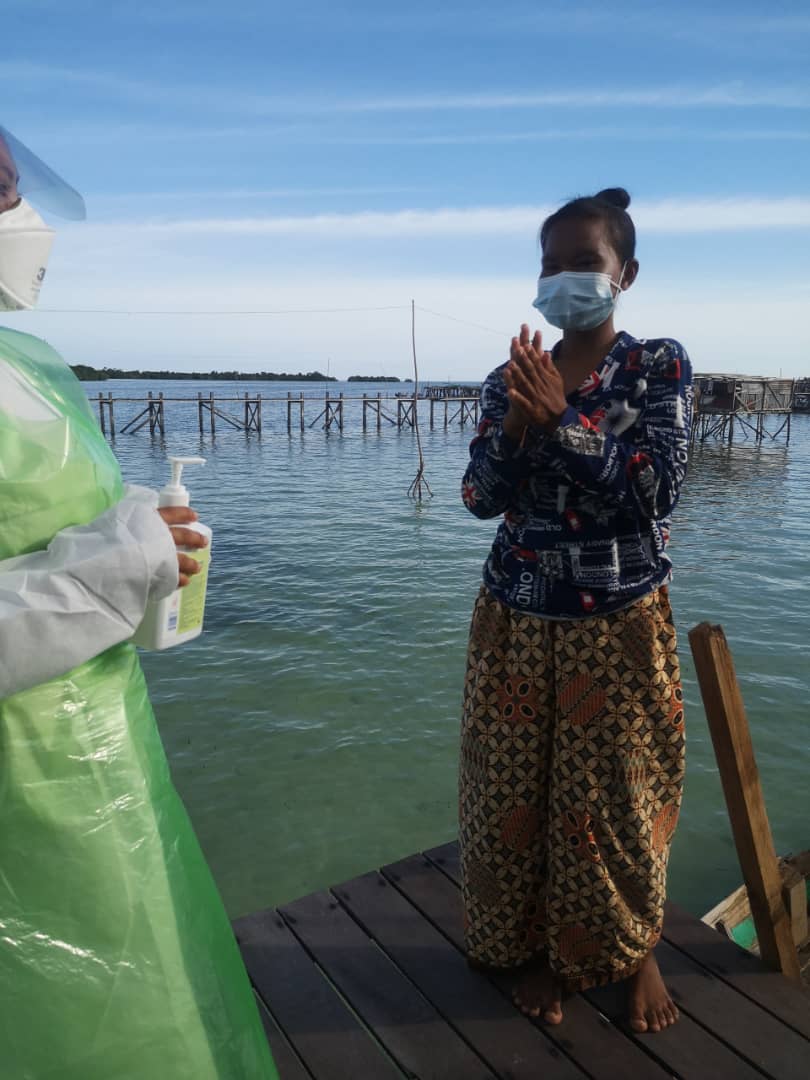
    Following the first week’s success, Iskul resumed our food air programme the following week. On the 30th of October, food baskets arrived from our partner, Borneo Komrad, who packed the food supplies on the mainland. Iskul rushed to deliver the food supplies to 122 stateless families on Omadal Island and the remaining households collected their food basket in Pondok Iskul the next day. Our efforts have rippled across the island and on November 5th, the Semporna District Officer provided food baskets to all residents in Omadal. The Iskul Team helped to distribute the food baskets to the stateless families.

    Programme 2

    began on the 20th of November when the Iskul team distributed food supplies, Vitamin C and mineral water to the residents of Omadal. Similarly, Wanita Pulao Omadal collaborated in distributing the food supplies to the Malaysian households while the Iskul team distributed the food supplies to the stateless families. Our food baskets included one pack of Panggi Kayu 6.5kg, one pack of Rice 5kg, one tray of eggs, 1 comb of banana, 1 watermelon, 1 can of condensed milk and 1 box of tea bags.

    We sincerely thank our partners (Semporna Heroes, Wanita Pulau Omadal, Imaret and Pejabat Kesihatan Daerah Semporna (PKD), F&N Malaysia, Borneo Komrad) for their efforts and contributions to the Omadal community during these trying times. We couldn’t have done it without your help!
  • Students’ Progress Evaluation (2015-2018)

    3 January 2020

    We analysed the progress and impact of the 16 students who have joined Iskul since the inception for 3 consecutive years from 2015-2018. The 16 students were given Test 1 on Sept 2016, Test 2 eight months after, followed by Test 3, a year later (March 2018). Assumptions made for this analysis are:

    • There were a minimum of 2 hours per class, 2 classes per week
    • Students’ attendance is at an average of 70% 

    Using these assumptions and data, according to national school days (5 hours/class, 5 days/week), they attended about 70 days or 14 weeks (less than 4 months) of school over the past three years.

    Overall, we are pleased with the result considering that the actual time our 16 students spent on a normal schooling period is just less than 4 months. Based on our observation, Iskul students have mastered basic numeracy, however, they are still mostly weak in the Bahasa Malaysia language, although most of them have no problem understanding and engage in basic conversation in Bahasa Malaysia. The greatest outcome is that two of our students from this test have now become Mastal Arikik (MA) to teach the new batch of students.

    From the result, we noticed the shift in students’ progress when we provide teaching camps to our MAs to improve their teaching quality and when we find SPM graduates to teach. We also like to note that the involvement of our Headmistress in teaching demonstrated that students learned faster. 

    In a nutshell, we found that MAs with better results can teach better and have better skills in transferring knowledge to the students, although it is not as efficient as having an adult/qualified teacher to conduct the teaching. 

    Moving forward, Iskul aims to:

    • focus on language mastery
    • consult a language (BM) teacher
    • create a learning-enabled environment
    • employ an adult teacher

    Iskul feels strongly that if the children do not continue practising what they learned, they will forget as time passes and it would be a waste. Therefore, for the graduating students, Iskul hopes to create programme(s) to encourage the students to continue learning and contribute to Iskul long-term. 

    The analysis’ results are divided into three parts:

    • Result 1: The basic evaluation criteria used during Test 1 for all three tests
    • Result 2: Further evaluation on Mathematics in Test 3
    • Result 3: Further evaluation on Bahasa Malaysia in Test 3

    Result 1: The basic evaluation criteria used during Test 1 for all three tests

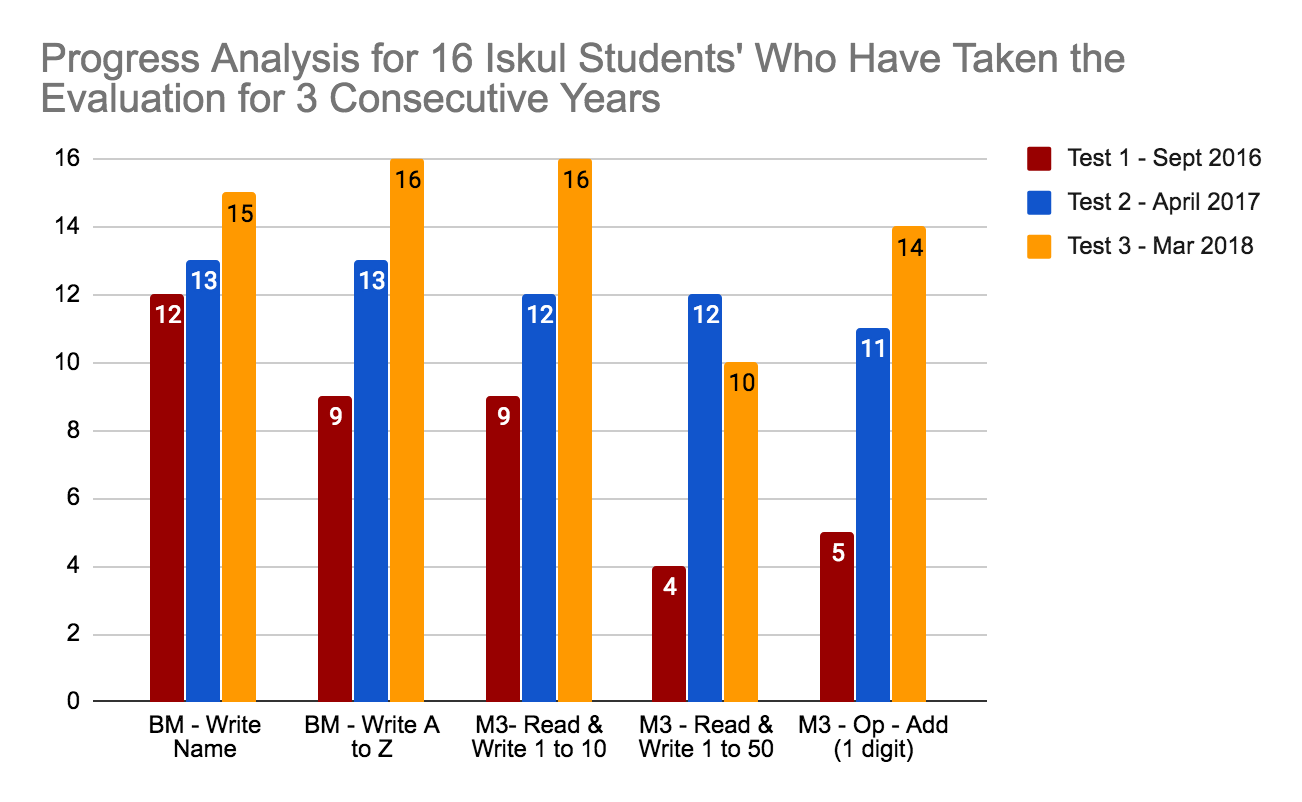
    Graph 1. Progress Analysis for 16 Iskul Students who have taken the Evaluation for 3 Consecutive Years

    As shown in Graph 1, there is a steady increase in the number of students who can perform all five basic criteria of assessment from Test 1 to Test 3.

    By Test 3, all 16 students can write A to Z and read and write number 1 to 10. All except for 1 can write his/her own name. Those who can do simple 1 digit addition increased by 19% to 14 students from Test 2. Oddly, two students digress from being able to write the number 1-50 to only 1-20. Further investigation reveals that their attendance is an average of 60%.

    Result 2: Further evaluation of Mathematics in Test 3

    In the further evaluation of Mathematics, the students were tested on how many digits they can write and recognise, reading clock and questions related to addition, subtraction, multiplication and division.

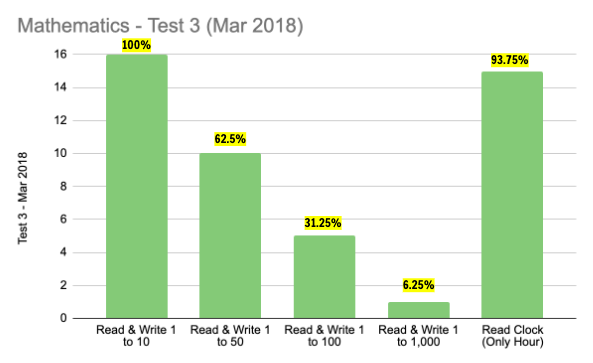
    Graph 2. Read and Write Number and Read Clock Result in Test 3

    Graph 2 shows that all students can write the basic number from 1-10, while only 10 students can write from 1-50. Interestingly, 1 student can write up to 1,000 and 5 can write up to 100. With regards to reading time, about 94% of the students can read only up to the “hour” hand.

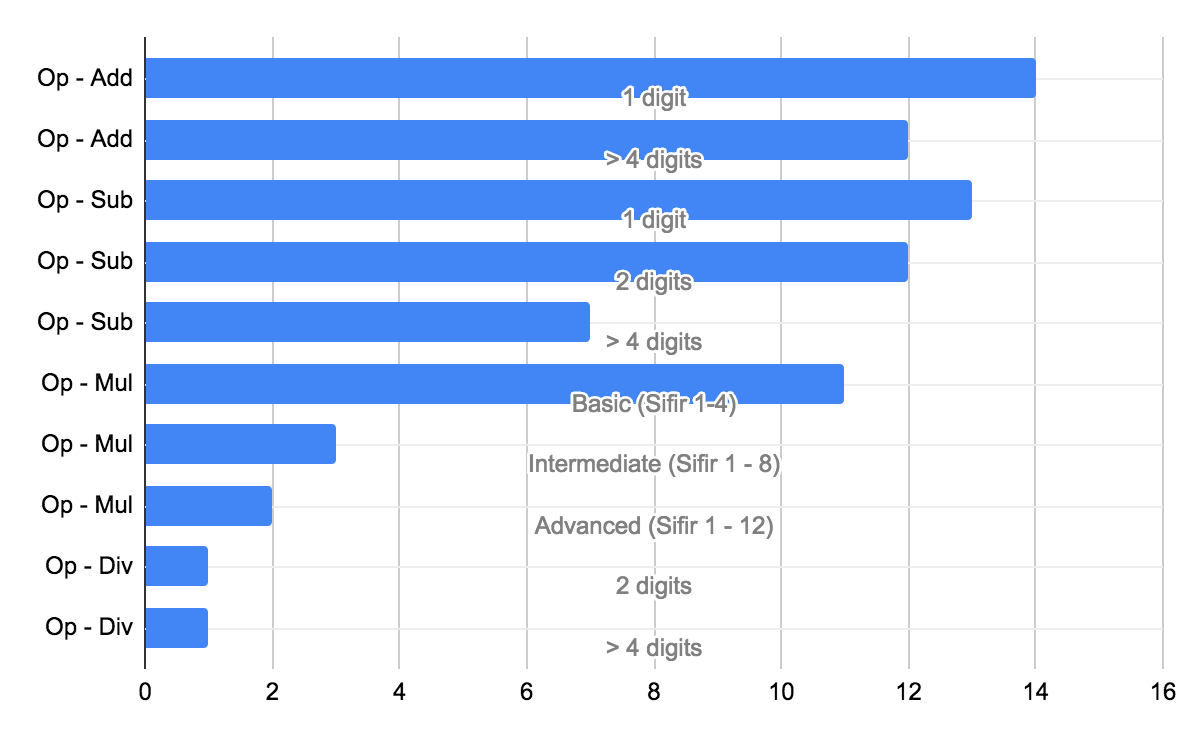
    Graph 3. Mathematical operations of addition, subtraction, multiplication  and division according to digits

    We’re delighted to note that more than 75% of our students can solve additional operation questions up to 4-digits. More than 70% of them can solve subtraction questions up to 2-digits while only 43% of them can do up to 4-digits. Furthermore, about half of them can memorise the multiplication table from 1 to 4. However, a majority of them are still unable to solve division problems. 

    Interestingly, one student has mastered the basic arithmetics – able to memorise multiplication table up to 12 and solve up to 4-digits division questions

    Result 3: Further evaluation on Bahasa Malaysia in Test 3

    Test 3 for Bahasa Malaysia evaluates students on two things: (1) recognising body parts and (2) recognising terms for family members.

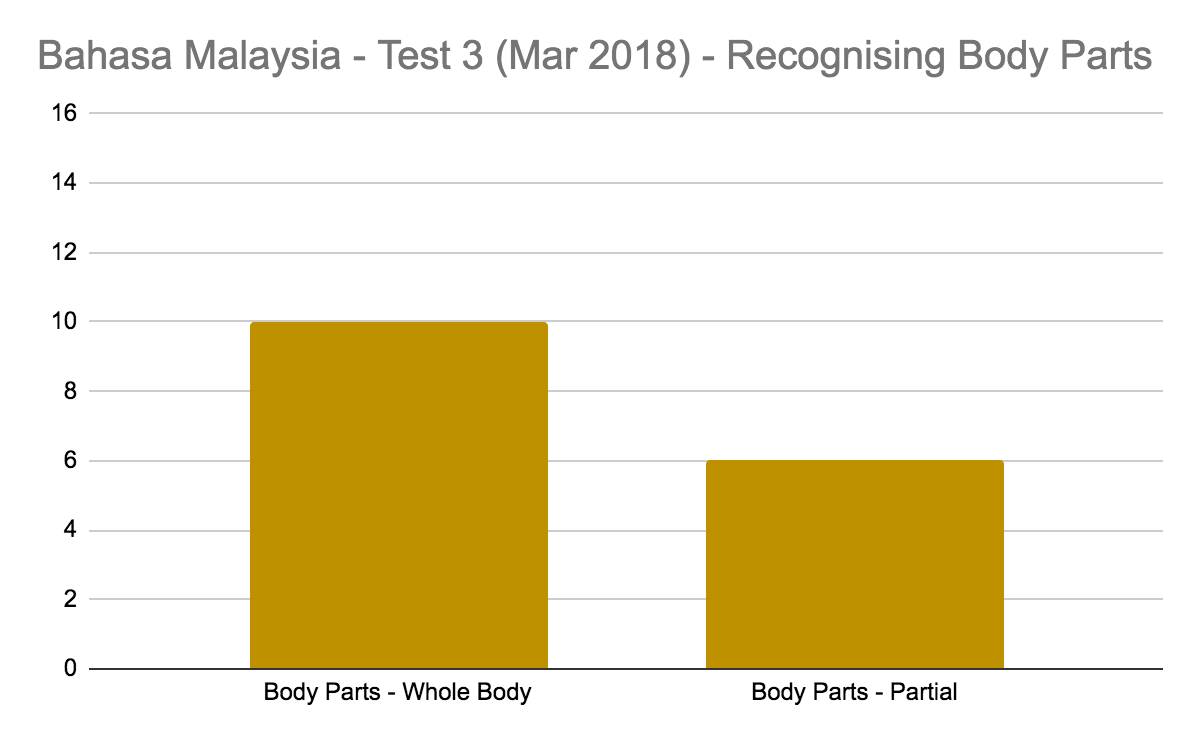
    For the former, 10 of the students can identify the whole body parts while the remaining 6 are only able to identify “rambut”, “mata”, “hidung”, “kening”, “ibu jari”, “kaki”, “perut” and “dahi” only. (Refer to Graph 4)

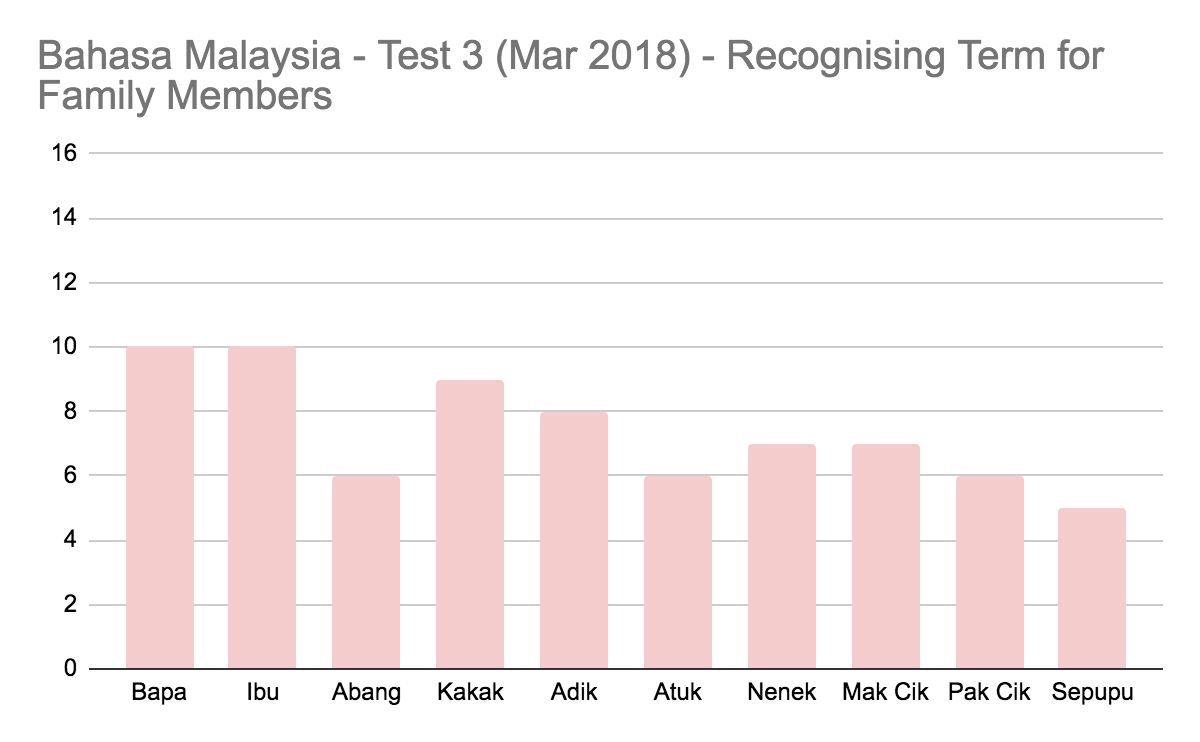
    As for the latter, firstly only 10 students can recognise the term for parents. Secondly, more than six students who can recognise terms for close family members (i.e., parents and siblings). Finally, a average of 39% of our students able to recognise terms for extended family members (i.e., grandparents, relatives) (Refer to Graph 5)

    Graph 4. The number of students who can recognise Body Parts in Test 3

    Graph 5. The number of students who can recognise terms for family members in Test 3.

  • Iskul Home Visits & Group Interviews (2019)

    “Home is where one starts from.”

    T.S. Eliot

    Since the formation of Iskul in August 2015, Iskul team has always wanted to visit homes of our students with the intention to meet their parents and other family members as well as to understand the condition of their living at home. It is important for us the team to meet the parents as we want to inform them that Iskul belongs not to any individuals exclusively but owned collectively by the Iskul community comprising of Iskul’s students and families. Additionally, being able to visit respective homes of the students enabled us to establish a rapport and for us to understand the condition under which our students return to after class. Such information allows us to build empathy and identify support that is essential to allow the children to attend classes to learn.

    During the field visit in September 2019, Iskul prioritised the visit to each and every home of Iskul’s students with the help of our in-training Field Coordinator, Khairul and Mastal Arikik Sakinas and Delah. In total, we have visited 16 homes.

    As the team visits from one home to another, we notice some distinct aspect of the Omadal stateless community which really puts the perspectives in place.

    The condition of the homes of our students, in general, is loosely categorised as:

    Living By, One Space for All: Stilt house made of rusty zinc rooftop including its four walls, and there is no distinct compartmentalisation of function spaces, i.e., kitchen, living space, bedroom etc. These houses only source of light is from the oil lamp and their source of drinking water is from the rain or the seawater surrounding them.

    Managing, Distinct Spaces: Stilt house made of leftover woods for its four walls and there are the obvious separation of functional spaces such as the kitchen and the living space/bedroom, with or without wall partitions. These houses may have electricity powered from the generator or connected from neighbouring stilt houses that are ultimately connected to the houses of the residents on the island. Their source of drinking water collected from rain.

    Stable, Comfortable Space: Stilt house made of plywoods for its walls and have several rooms compartmentalising functional spaces such as the kitchen, living room, bedroom, and toilet/shower room. These houses have electricity and collect rainwater in large tanks.

    Besides the materials their houses were made of and access to electricity, we also observe that they prioritise procurement of certain furnishing that mark the improvement of their living standards. Two of the main items they will attain for the display of change are audio speakers and kitchen utensils. We think that this also informed us of their sense of community because the availability of these items showed that they are able to share and to host neighbours. During our annual visits, we found that several houses with speakers and electricity enjoy blasting music over their speakers and it is so loud we could hear from across! There is usually no particular reason for the festive. We are in the opinion that it is just their way of breaking the silence of the night or perhaps a boost of energy as they prepare for their weekly fishing trip out into the sea.

    The ability to work independently also directly reflects their state of income. If the sole breadwinner of the family works for another fisherman, their means of income are usually the lowest with less than RM5 per day. Meanwhile, if the family has a boat and dry their catches of the day for sale in the town, they are most likely making more than RM50 per day, also depending on the catch per trip.

    “Home can be a happy place with surety, knowledge and security; but it can also be a place where people develop confusion, doubt, and a low self-image.”

    Christian Olsen

    Indeed, we observed that children from the impoverished family are more reserved and shy when in class and often comes to class, dishevelled. However, over time, we noticed progressive changes when we help them be aware of the importance of keeping nails short and clean and combing their hair, tying up if wanted to. Their appearance becomes neater and they become more confident. We noticed that boys start learning to style their hair while girls learn to put on eye shadow and lipsticks as well as having fancy clips when they come to class. Although Iskul may be seen as a source of income for some, the changes we have seen in the students are comforting and it is what motivates us to focus on servicing our beneficiaries and their well-being.

    Besides home visits, Iskul also conducted group interviews as one of our consistent method of assessing/evaluating the impact of lessons provided to our students in Iskul. Due to the new intake of students in May, most of our current students have only attended less than two (2) months’ classes, thus, many are still unable to recognise or identify A to Z and numbers. Nevertheless, many of them are able to recite A to Z in one go. During the group interviews, we observed that they are still shy when in contact with us – a stranger to them as they have only seen us probably the first time. When asked if they like coming to Iskul, they nod their heads in much eagerness and tinge of excitement. When asked for a reason, many of them simply just want to ‘belajar menulis….membaca’. And that is really what mattered.

    Although Iskul is now educating a new batch of students, we are eager to reconnect with our students from the pioneer batch. They have all grown into fine lads and ladies. After losing our Field Coordinators in early of the year, they have not returned to Iskul, except two of them who are now teaching our new batch of students. We are informed that the reasons are that (i) there are no more (adult) teachers who could teach them, and (ii) because of that, they do not think they can learn more from Iskul. It is a crucial point we reflect on. Iskul has been practising the concept where peers teaching is the key – school-going Malaysian teens teach their friends from the stateless community. As we conclude the fourth year, we realised that this concept limits the learning potential for our students as most of them are the same age as our Master Arikik and our Master Arikik are also students who are performing less than average at school. Hence, we find their request for an adult (or qualified) teacher as reasonable and a request we prioritise for the year 2020.

    A quick one-to-one evaluation with a few of our pioneer batch students revealed that they can still identify, read, and write A to Z, numbers from 1-100, and do simple calculations. We are also exceptionally glad that we are able to hold the session with them in Bahasa Malaysia! While these are great news, it also justifies that we need to open classes for these advanced students to learn more and create other activities for them to stay connected with Iskul such as creative classes and alternative livelihood plans. Iskul wants to continue to inform and make aware that Iskul is established for the community and one day, we hope that it will be maintained by the community, therefore, we will continue to review our progress and be conscious of our effort to empower them.

  • Annual Field Visit 2019 (Finally!)

    For the most part of the early journey from the Tawau Airport to Semporna, the view is mostly oil palms and coconut trees, bushes, and occasionally, houses. Well, the road definitely has greatly improved as there are no more dangerous potholes. Ah, still the familiar trip nonetheless!

    It has been over two years since any of the management team members visited Semporna and boy, did the town changed! As the distance to Semporna town closes, the first obvious change is the lack of rubbish on the roadside where previously it was almost unmissable. Well done, Sempornians!

    As the major eyesore issue is now finally taken care of, there was really nothing major we thought Semporna really need, but boy oh boy, the town has upgraded! The second you passed the archway that welcomes you to Semporna, a 5-6 storey high new hotel greets you. Then, there is a McDonald’s! If previously you needed to make a trip to Tawau (the next nearest town) for the fast food, now you do not need to! New concept lodging facilities mushroomed all across the town and you can hardly miss it because it is just so-out-of-place (in a good way, perhaps?). Restaurants and fancy cafes are also spotted as you approach the centre of the town.

    When you approach the most happening side of the town, well, apparently, it is no longer the most happening side anymore because a Seafest Mall with Starbucks and Tealive has been constructed on reclaimed land on the northeast side of the town. Wow.

    We wonder if Omadal Island has changed too?

    The road heading to Jeti Umum Semporna situated near Giant mall Semporna remains very much the same – crowded and wet as catches of the day are being traded. The journey to Omadal begins by getting on a 12-15 person passenger boat to Balimbang. The whole journey takes about 45-60 minutes to reach Omadal Island. Nothing has really changed in this part of the journey, apparently.

    Upon arriving Omadal Island, find your way to the resident of the Ketua Kampung to make your presence known and then register yourself at the General Operations Force (Malay: Pasukan Gerakan Am; PGA) centre for security check and protection.

    All in all, Omadal Island has not changed much. The goats are still roaming around, grazing on any plantations they can find, the turtle hatchery and the football court. Well, there is now a beautifully re-constructed Balai Raya (Community Hall) and a fully functionally mosque.

    After making our obligated rounds, we finally visited Pondok Iskul! Since the completion of its construction, the management team has not made any official (physical) visit and this time, we will be putting up in the Pondok for the next 10 days! As we toured the space, we were overwhelmed by gratitude that this dream of a conducive learning space is a reality!

    The trip was a packed one as we arrived just in time to celebrate Malaysia Day on 16 September. Following that, visits to the homes of our Iskul students were also arranged in an effort to register them officially and to gather basic family background. Our group interviews with 3-4 students in one session were also conducted to evaluate the current understanding of our new batch of students and find out if our previous batch students still remember the lessons they took.

    Whilst Omadal Island remains peaceful and calm, it has recently been receiving more visits from groups of loud foreign tourists carrying professional cameras. Children from the stateless community gathers upon receiving news of incoming visitors and soon gathered around these visitors. One young girl instinctively began “modelling” in the signature pose of flipping their long hair, and younger kids with their wooden boats are asked to flip over into the water as these visitors start snapping away. Once, we observed that the group of tourists intentionally bought coloured powder packets and with the help of a local tourist guide, they have “orchestrated” so that the children are on gathered on the boat and on their count, to release the powder for photograph effects.

    The scene was very difficult to observe, however, we are in no position to stop them because we are not a resident of the Omadal Island and for all we know, these visitors have sought permission from the Ketua Kampung.

    Nonetheless, we have a few burning questions we are dying to ask:

    To a tourist guide:

    • Why would you bring tourists to go watch stateless children and allow them to request these children to make a circus out of themselves i.e., flip hair, jump off the boat, etc?
    • Why is it that it is not okay with Malaysian children but okay with stateless children? They are children all the same, isn’t it?
    • Why would you allow tourists to take thousand dollars photo of stateless partially/fully-clothed children and in return, they only received small packets of sweets, snacks and maybe few ringgits as compensation for their “modelling effort” and their unique skin colour and background

    To the residents of the neighbourhood village:

    • Why would you allow such exploitation in the backyard of your own house and to the community that have stayed your neighbour for many years?

    To the visiting tourists:

    • Why did you think it would be helpful to compensate them with snacks and few ringgits for the effort these kids take in “modelling” under your instruction?
    • Why would you think your photos could make any difference to the state of these communities?
    • Why would you be trespassing on the privacy of these children for your own selfish needs of photography portfolio or travel memories? At some point, where is your photography etiquette to ask these kids to either remove their shirt or put on their shirt or change their shirt to fit your photography needs?
    • Do you really think that the amount you pay the guide to take you to these communities benefits the communities at all?

    As the sun sets on Omadal Island on the day before we leave, we realised that while the Semporna town has changed exponentially for the past 2 years, none of these developments has positively impacted the stateless community on Omadal Island.

  • Pondok Iskul Dream Made Possible with Mah Sing Foundation Grant!

    After submission of application in September, Iskul received notification of approval from Mah Sing Foundation for our application for funds to construct Pondok Iskul. Mah Sing Foundation had allocated RM 50,000 fund for the construction and basic furnishing of the space!

    Iskul jumped into work immediately and kickstarted the purchasing of raw materials and recruitment of builders. The construction and the furnishing took a total of six (6) months. Classes commenced in the Pondok once the construction was completed in February and whilst the furnishing was in progress.

    At the moment, Pondok Iskul electricity is hosted by the nearby home of our Headmistress and the registration with the SESB is underway.


    Thank you, Mah Sing Foundation and all who have funded this dream!

  • Year 1 – The Experiment

    Year 1 has been a colourful year for Iskul. Here are some of the highlights:
    • Our Mastal Arikik divided the school to two classes: beginner and intermediate. They created school anthems and the students sing the anthem at the beginning of every class. Some students now can count from one to hundred, do simple addition and minus operation, read and write from A to Z. So far, they had a number of tests. The average class size is around 21-24 students. They are given homework after every class. And they also have ‘gotong-royong’ after their Sunday class to keep the beach clean. The Mastal Arikik also conducted extra classes during their school holiday in December 2015. (Aug,2015 – Sept 2016)


    • One of our Mastal Arikik was nominated as Unicef Young Changemaker 2015 that has garnered much attention to Iskul. As a result, the Trustee created an InfoKit for media, potential donors and Volunteer Tutors who wish to contribute to Iskul.


    • A video called Mastal Arikik were produced by WAPO and presented during a meeting with Datuk Masidi Manjun – Ministry of Tourism, Culture and Environment Sabah during the meeting he was surprised and proud of the Iskul initiative and the local kids for teaching the Bajau Laut friends. (Dec 2015)


    • For the first year, Iskul spent RM500 monthly to cover the four Mastal Arikik allowance (RM50) and the students food after every class. We have one monthly donor. We also received donations in form of workbooks, bags and toys.


    • The Trustee has ten online Board meetings and made four visits to Iskul from Aug 2015 – July 2016. We also welcomed a new member into the Board of Trustees, Shafiyyah on July 2016.


    • The Trustee made an assessment trip to Omadal on September 2017, and identified four gaps to be addressed:
      • lack of proper classrooms and it has affected our students attention during class
      • our MA has yet to master the teaching skill, they would need more trainings to teach better
      • lack of monitoring and supporting mechanism on the ground for our Headmistress, MA and students
      • lack of self-esteem and high-consciousness amongst students.


    • Iskul celebrated its one year anniversary and Awards Day on 20 September 2017 to celebrate the time and efforts our students, Mastal Arikik, Headmistress have invested in Iskul! We had invited our student’s parents to witness the historical moment when their child walks up to the stage to receive a certificate of enrollment from the Head of Omadal Hujung village.


    • To improve our MA’s teaching skills, our friend Cikgu Wai Yan guided them on how to prepare a Teaching Plan before class on 24 September 2016.


    • After one year, 71% of our students can write their own names while 57% can write A-Z based one a test result conducted in September 2016


    • On November 2016, Hui Ling attended YSEALI GO NGO on behalf of Iskul to seize the opportunity to introduce Iskul and its journey thus far to other participants while very much looking forward to receive their collective ideas on how to better improve Iskul because there is no one fits all solution. Indeed, Hui Ling returns with abundance of reflections and eager to bring the knowledge she obtained from speakers during the workshop which she proposed would be suitable for Iskul to consider or adapt.


    • The Board of Trustee (BoT) had a two-day Strategic Planning Meeting online in January 2017 to reevaluate, restructure and plan Iskul’s milestones for the next 12 months. One major change is the restructuring of the BoT as each member assessed our circumstances and commitments to Iskul. For now the BoT cease to exist and we are absorbed as the Iskul Management Team. For the purpose to increase accountability, transparency and legality, we have also registered an enterprise named Kahanga Enterprise where official account can be registered and bank statements can be audited in the future.


  • The First Annual Assessment Visit

    The Board of Trustee (Trustees) conducted our first annual assessment visit to Iskul Sama diLaut Omadal from 14 to 30 September. Hui Ling and I flew to Semporna to meet Adzmin and Shafiyyah at our own expenses. This 17-day trip provided us better understanding of Iskul’s classes, students, Mastal Arikiks (little teachers in Bajau) and the headmistress. As insightful as the trip may be, however, it was not without challenges.

    The first challenge was the security risk. Two days before our depature, news reported kidnapping of a fisherman off Semporna water. Our dive operator friends advised us against staying on the Omadal island. Interestingly, local islanders feel otherwise. Semporna town residents find it dangerous to travel to non-touristy islands i.e. Omadal but the islanders disagreed. Honestly, we were worried for many days, before and during the visit, especially on our trip to and fro Omadal. For security reasons, when in Omadal, we reported our presence to the General Operation Force’s (Pasukan Gerakan Am, PGA) base. We randomised our visits to the island and stayed a total of 10 nights. PGA advised us against roaming around when darkness sinks in. Overall, throughout the visit, we didn’t wander too far off the kampung areas. We find the island pleasant to visit especially to interact with Bajau Laut children as they gather in the evening to play. However, this security risk made it infeasible for outsiders like us to work in Omadal.

    Throughout our stay, we conducted (i) seven Focus Group Discussions of threes with most of our students, (ii)13 individual interviews with our students, little teachers and headmistress,(iii) two impromptu tests for both our students and little teachers and (iv) observations as ways to collect data to understand Iskul better. Hui Ling and myself also taught a few classes which helped us to understand why our little teachers splitted the students into smaller group for better management. It was a joy to see our students eagerness in learning and wanting more classes. They were proud of their new Iskul’s t-shirt and wore it for all classes. They also displayed a persistent spirit in completing all test questions despite not knowing the answer.

    Unfortunately, our in-class observation showed that our Mastal Arikiks are weak in teaching. Students were taught to memorise without understanding what they were learning. The class typically began with the little teachers writing on the board and students copied what was written. After about 45mins, the little teachers read out the words, but  always explaining what it means. Futhermore, their teaching methods and class control lack creativity and fun elements.

    The difference between the students’ eagerness in learning and the Mastal Arikiks’ lack of enthusiasm and teaching skills is apparent. Our little teachers had no teaching plans and repeated words taught previously. We were disappointed at this discovery. However, we understand that our Mastal Arikik are still young and they don’t have the capacity to teach like teachers. Their teaching methods possibly reflects how they learn in school (which indicates a greater problem in our national education system)! Hence, we invited a friend, Cikgu Wai Yan to guide our MA on how to prepare lessons before class.

    Nonetheless, a few students can read/write/recognise A-Z, 1-50, certain words, while the rest are still learning. Together with the Mastal Arikiks and headmistress, we reshuffled the classes according to the students’ level. As our fund was running low and to reevaluate our young teachers’ teaching motivation we resolved to remove their RM50 monthly allowance for the next six months from October 2016 to March 2017. As a result, two Mastal Arikiks who recently joined us quitted. They even discouraged other children from teaching in Iskul without allowance. Thankfully, our three founding Mastal Arikik decided to continue teaching despite no allowance.

    Another shocking discovery is our Mastal Arikiks’ poor school results. Their grade for Bahasa Malaysia and Mathematic are below 40 marks (fail). This shattered our initial assumption that our little teachers pass all their subjects in school.

    Hence, we refocus the project into two fold. Firstly, to provide basic literacy to the stateless Bajau Laut children. Secondly, to build capacity of rural students in Malaysia. We want to build young leaders within these two communities.

    Therefore the next one year, our focus will be:

    • To build the capacity of our young teachers so they can teach
    • To fundraise to build a structure for Iskul so that the children have a proper place to learn
    • To elevate the self-esteem of out students – to empower them to become assistant MA to teach their friends, and hopefully they can become MA later.
    • To hire a field coordinator to support the Mastal Arikik, students and headmistress as well as to become communicator between them and the Trustee and more


    The assessment trip was intense, we had so many ideas but we can’t implement them without being there. The funding coupled with the security issue made it hard for us to work in Omadal. Nonetheless, we are resolved to continue to support Iskul and to build leaders among the stateless and local communities in Semporna!

  • Students’ Progress Evaluation after 1 Year (September 2016)


    The above table and chart only depicts the performance of 21 Iskul students based on written examinations drafted and evaluated with designated marks conducted in September 2016. Our observations shows that our students are able to enumerate the alphabets from A to Z and 1-50 eloquently.