Several years have passed since Khairul, our co-founder was nominated for this award. His work with Iskul still makes a huge difference in the lives of the stateless children on Omadal.
Khairul is Iskul’s co-founder and pioneer Mastal Arikik. He was one of the first to teach the younger students. This formed the basis for our educational structure at Iskul. Not many young boys want to spend their free time after school teaching others. But, he picked up the role and continues to advocate for his community till today. He conducted the first trial class at 14, and committed to teaching on weekends.
After SPM, he stepped up as the Field Coordinator trainee. His background and experience provides insight to the Malaysian and stateless communities of Omadal Island.
He began training as the Field Coordinator in 2020. He is now in charge of Iskul’s meals and organising activities. He also acts as the key link with orang Kampung and external parties. Additionally, he is responsible for documenting Iskul’s activities.
Watch the video on his nomination below!
Fifteen-year-old Mohd Khairul Bin Atim was born in Pulau Omadal, Sabah. He spends his free time making sure that the Bajau Laut children in his village are capable of reading. He also ensures they can write.
He is one of 10 finalists of the inaugural Tuanku Bainun Young Changemakers Awards 2015.
Year 1 has been a colourful year for Iskul. Here are some of the highlights:
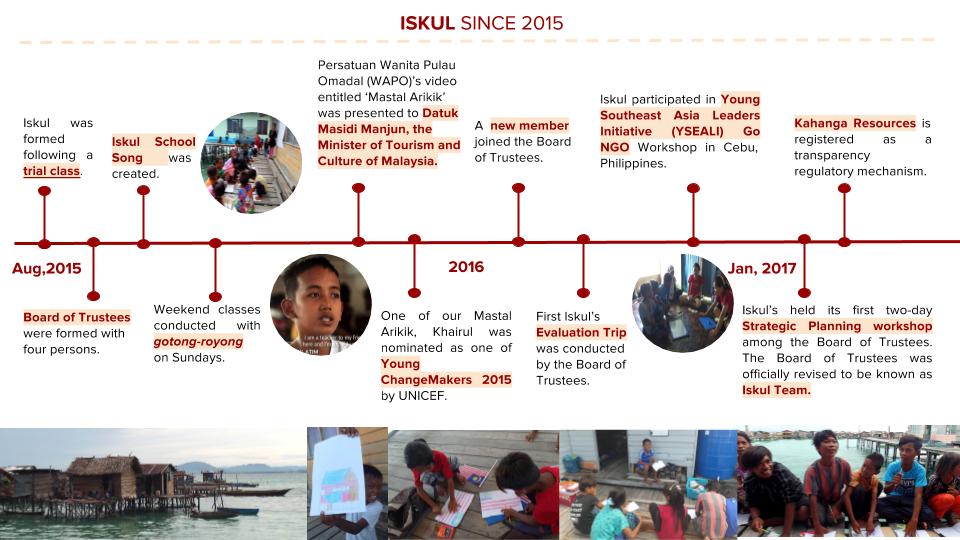
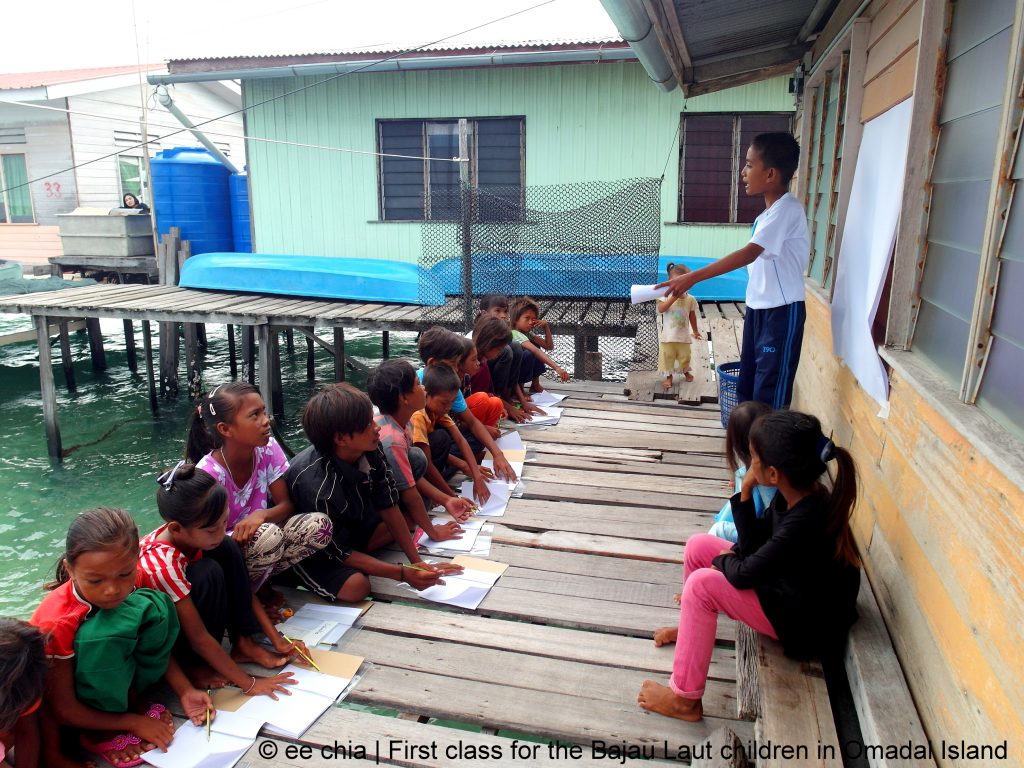
Our Mastal Arikik divided the school to two classes: beginner and intermediate. They created school anthems and the students sing the anthem at the beginning of every class. Some students now can count from one to hundred, do simple addition and minus operation, read and write from A to Z. So far, they had a number of tests. The average class size is around 21-24 students. They are given homework after every class. And they also have ‘gotong-royong’ after their Sunday class to keep the beach clean. The Mastal Arikik also conducted extra classes during their school holiday in December 2015. (Aug,2015 – Sept 2016)
One of our Mastal Arikik was nominated as Unicef Young Changemaker 2015 that has garnered much attention to Iskul. As a result, the Trustee created an InfoKit for media, potential donors and Volunteer Tutors who wish to contribute to Iskul.
A video called Mastal Arikik were produced by WAPO and presented during a meeting with Datuk Masidi Manjun – Ministry of Tourism, Culture and Environment Sabah during the meeting he was surprised and proud of the Iskul initiative and the local kids for teaching the Bajau Laut friends. (Dec 2015)
For the first year, Iskul spent RM500 monthly to cover the four Mastal Arikik allowance (RM50) and the students food after every class. We have one monthly donor. We also received donations in form of workbooks, bags and toys.
The Trustee has ten online Board meetings and made four visits to Iskul from Aug 2015 – July 2016. We also welcomed a new member into the Board of Trustees, Shafiyyah on July 2016.
The Trustee made an assessment trip to Omadal on September 2017, and identified four gaps to be addressed:
lack of proper classrooms and it has affected our students attention during class
our MA has yet to master the teaching skill, they would need more trainings to teach better
lack of monitoring and supporting mechanism on the ground for our Headmistress, MA and students
lack of self-esteem and high-consciousness amongst students.
Iskul celebrated its one year anniversary and Awards Day on 20 September 2017 to celebrate the time and efforts our students, Mastal Arikik, Headmistress have invested in Iskul! We had invited our student’s parents to witness the historical moment when their child walks up to the stage to receive a certificate of enrollment from the Head of Omadal Hujung village.
To improve our MA’s teaching skills, our friend Cikgu Wai Yan guided them on how to prepare a Teaching Plan before class on 24 September 2016.
After one year, 71% of our students can write their own names while 57% can write A-Z based one a test result conducted in September 2016
On November 2016, Hui Ling attended YSEALI GO NGO on behalf of Iskul to seize the opportunity to introduce Iskul and its journey thus far to other participants while very much looking forward to receive their collective ideas on how to better improve Iskul because there is no one fits all solution. Indeed, Hui Ling returns with abundance of reflections and eager to bring the knowledge she obtained from speakers during the workshop which she proposed would be suitable for Iskul to consider or adapt.
The Board of Trustee (BoT) had a two-day Strategic Planning Meeting online in January 2017 to reevaluate, restructure and plan Iskul’s milestones for the next 12 months. One major change is the restructuring of the BoT as each member assessed our circumstances and commitments to Iskul. For now the BoT cease to exist and we are absorbed as the Iskul Management Team. For the purpose to increase accountability, transparency and legality, we have also registered an enterprise named Kahanga Enterprise where official account can be registered and bank statements can be audited in the future.
Semporna has many beautiful islands, endowed with turquoise water and pristine sand – look almost like heaven on earth. Yet if you walk around Semporna downtown, you will see many children running around barefooted, begging for money and food.
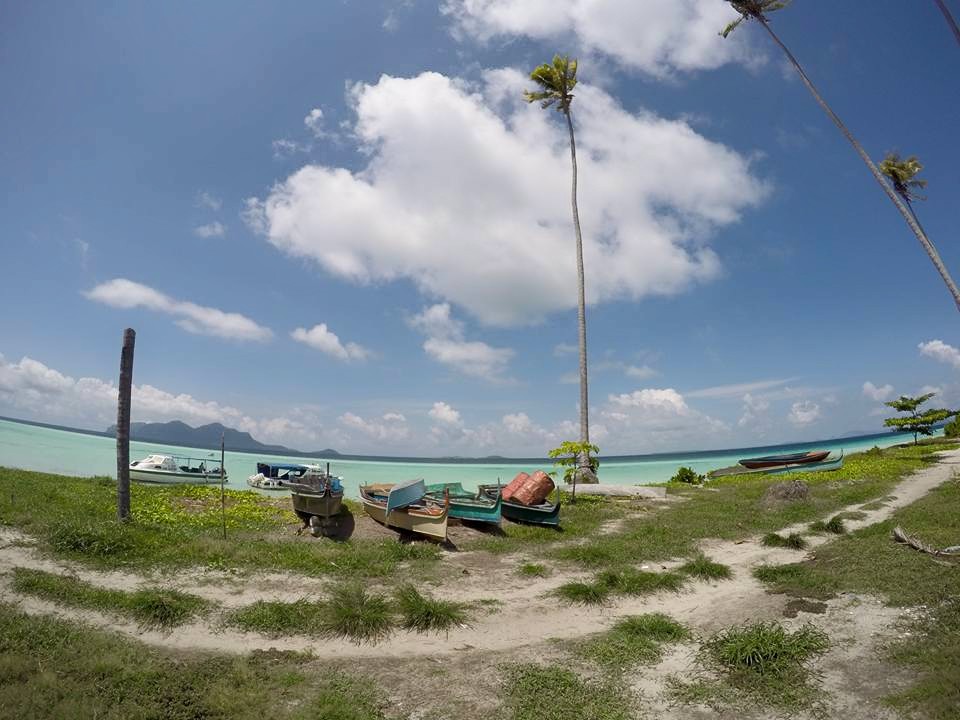
A serene view of the coastline in Semporna, showcasing traditional boats and lush greenery against a backdrop of turquoise waters and a clear blue sky.
Occasionally, you find a woman walking with them. These children mostly have hair with golden streaks. This results from the sea-water bleaching since young. They are the children of the subsistence Bajau Laut fishermen. Most of them have no national identity even though they are born here.
In the 1970s, many parents fled the armed conflict and political instability in Southern Mindanao, the Philippines. They sought refuge in Sabah.
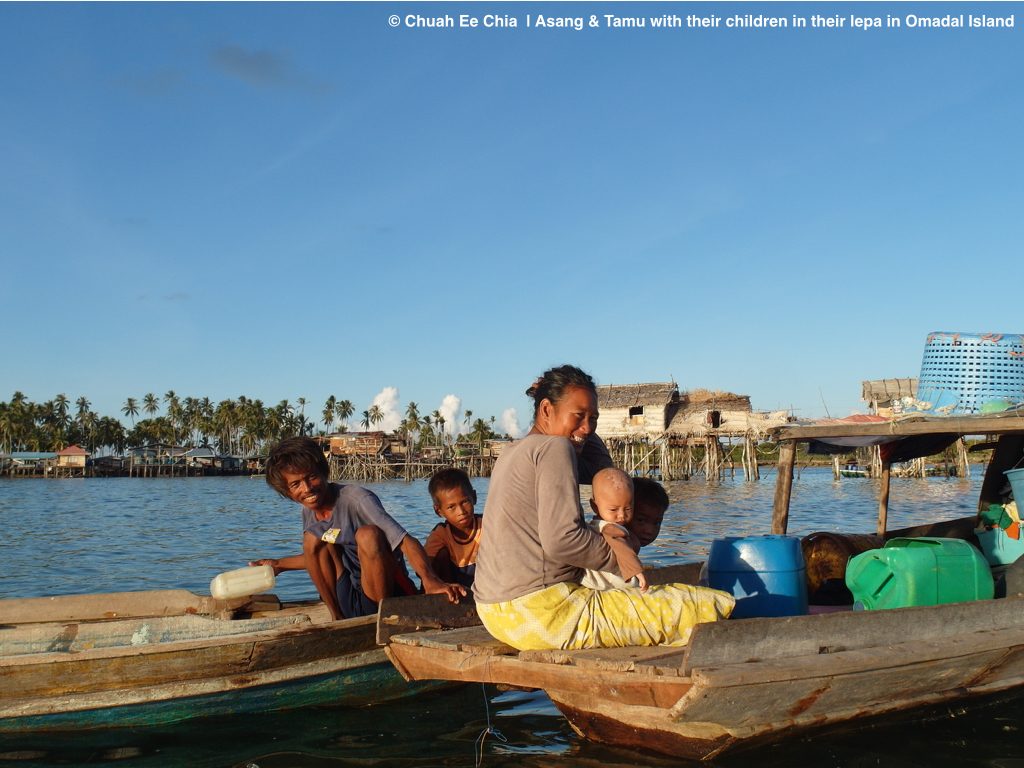
The Bajau Laut are also known as subsistence fishermen and sea nomads. Some of them still live in their traditional wooden boat known as lepa-lepa. Others have moved into wooden stilted houses. Both the lepa-lepa and house have no electricity and fresh water.
The Bajau Laut children are trapped in the inter-generational cycle of poverty. Having no Malaysian citizenship, the children are incapable of attending school (or even work).
When they are not fishing with their parents, they are left roaming in the town, begging for food and money. In recent time, many of them have started the habit of glue-sniffing. It was said that children sniffed glue to escape the feeling of hunger.
You asked the children what they feel when they sniff glue. They would tell you tales of an out-of-body experience. They feel a happiness that casts all their worries and humiliation away. They became addicts. These were my observations during my thesis fieldwork on the Bajau Laut community in Semporna.
When I was in the Omadal island for my fieldwork, I was taken aback. I saw similar patterns with the Bajau Laut children there. They sniff glue. They hardly speak Malay. They were not capable of attending school.
Once, I get to speak to the children through a little girl of Bajau Laut and Bajau parentage, Sakinas (Kinas). She became my translator as she can speak both Malay and Bajau. Through her, I asked the Bajau Laut children (mostly her cousins and playmates) if they want to go to school. Many of them shook their head because they think they are not smart enough for school.
Many feel shy and inferior to be in school as they have never been to one. I then asked if they would give it a try if Kinas teaches them instead of a schoolteacher. Their eyes brighten up and nodded their heads. I asked the 11-year-old Kinas if she’s willing to teach her friends on weekends and receives a small allowance. She nodded.
The first meeting after the trial class.
I quickly ran back to discuss with my host, Kak Roziah. She agreed to the idea. She introduced two more people: her 11-year-old son, Fazlan, and a 14-year-old teenager, Khairul, who can also be teachers.
We promptly had a meeting. The three young teachers, Kinas, Khairul and Fazlan, agreed to a trial class (you can view the video here).
During the trial class, they decided that they needed one more teacher to help, so they included a 14-year-old Syakila. That night, after the trial class, we had a meeting – the four young teachers, Kak Roziah and myself. The young teachers were all so excited and energised after their first teaching experience.
I asked how did they feel, they replied “Best!” and indicated that they want to continue teaching. We discussed about the setup. The school name is Iskul Sama DiLaut Omadal (Iskul).
We talked about its vision and the allowances. The allowances are not confirmed as they depend on donations. We also discussed the teaching plan, classes, and other details. Everyone spoke their minds and we recorded our decisions in the meeting minutes. They agreed to teach their Bajau Laut friends basic literacy, arithmetic and arts.
The next day, I travelled to Semporna town with Khairul and Kak Roziah. We went there to get the necessary stationery. I also posted a plea for donation on my Facebook for Iskul! So, we finally started our first class 1 of August 2015!
The formation of the Iskul would not be possible without the support of many friends. They donated in cash and in-kind to sustain its operation for one year.
We created a Board of Trustees (Trustees) because Iskul was (and still is) not registered. The Board was formed to keep tabs on donation and expenses. It also supports and oversees the operation. The Trustees was formed in August 2015 when Adzmin and Hui Ling joined us.
We meet bi-monthly to discuss Iskul progress. We disburse monthly allowance to the young teachers. They are also known as Mastal Arikik. This means Little Teacher in the Bajau language.
The last one year has been a learning experience for the Board of Trustees. Personally, I observed the pivotal role of local knowledge. Local community participation also plays an essential role in the sustainability of the project. It is the ownership of the local community that spurs the project further.
The Bajau Laut children also taught me an important lesson. According respect and dignity to the recipients of aid unlock the potential they have. I have not seen any group of children who are so eager to learn as these stateless children of Omadal. I’m ever grateful for this experience.